
SEO For Beginners
OR ANYONE TOO AFRAID TO ASK WHAT IT IS AT THIS POINT
My imposter syndrome finds it important to tell you I’m not an SEO expert. But if you’re here, neither are you so might as well listen to what I have to say. I’m a small business owner and I’ve learned a lot about SEO to keep my shit afloat. Having been in a position where I knew literally nothing and needed to get it figured out, I wanted to write a blog for anyone else that’s in that position. The position where if you don’t know anything you probably feel really behind and should at least have a baseline knowledge of what the fuck is going on. I’ll try my best to explain SEO in a way that normal, ordinary humans understand.
WHAT THE HELL IS SEO?
SEO, or Search Engine Optimization, is when you intentionally create your website in a way that your site or page shows up higher on the results page when someone searches for something like:
“physical therapy near me”
“personal trainers for beginners”
“why does my back hurt when I sneeze?”
“my kid sucks at baseball, what can I do?”
There are a ton of ways to do this. Things like keyword research, perfecting your website copy, making sure your website is also optimized for a phone layout, and putting alternate text on your images are all ways to improve your SEO. When people talk about SEO, it means they’re taking all of these steps to try to get their site to pop up when people search for their product or service on a search engine.
WHAT THE FUCK IS A SEARCH ENGINE?
More often than not, this is going to be Google and it will be what I refer to through the rest of this because we’ve turned the word Google into a verb to search for something online. But some people are still using Yahoo or Bing, or maybe you’ve transferred over to DuckDuckGo. All of these are search engines. And without getting too deep into it, AI is also technically a search engine but I’m not touching that.
A search engine crawls, indexes, and ranks websites to determine who shows up in the results to give you the best answer when you search for something. And if that sentence makes no sense to you, stick with me.
CRAWLING, INDEXING, AND RANKING
Crawling is when Google sends out these little spider bots to websites and they dig around each page to know what the fuck is going on there. Google needs to know what your site is all about so these little bots go figure it out.
Indexing is when Google takes the information the bots find and then categorizes and organizes it to make sense of it. Think of this like a library organizing books so they know exactly what they’re about and where to find them. Once they have all of this information, your site (or each individual page) is given a ranking.
Ranking is your relative position on a search engine results page and the entire purpose of SEO. A good ranking means you show up first, a shitty ranking means you don’t show up at all. Ranking isn’t all encompassing…the ranking depends on what someone is searching for. So for example my ranking for PT logo design might be #7 but my ranking for horse photos is #839,549,245. And if we’re being honest, your ranking is a lot more arbitrary than I make it sound.
YOUR SEO RANKING IS MORE HYPOTHETICAL THAN REAL
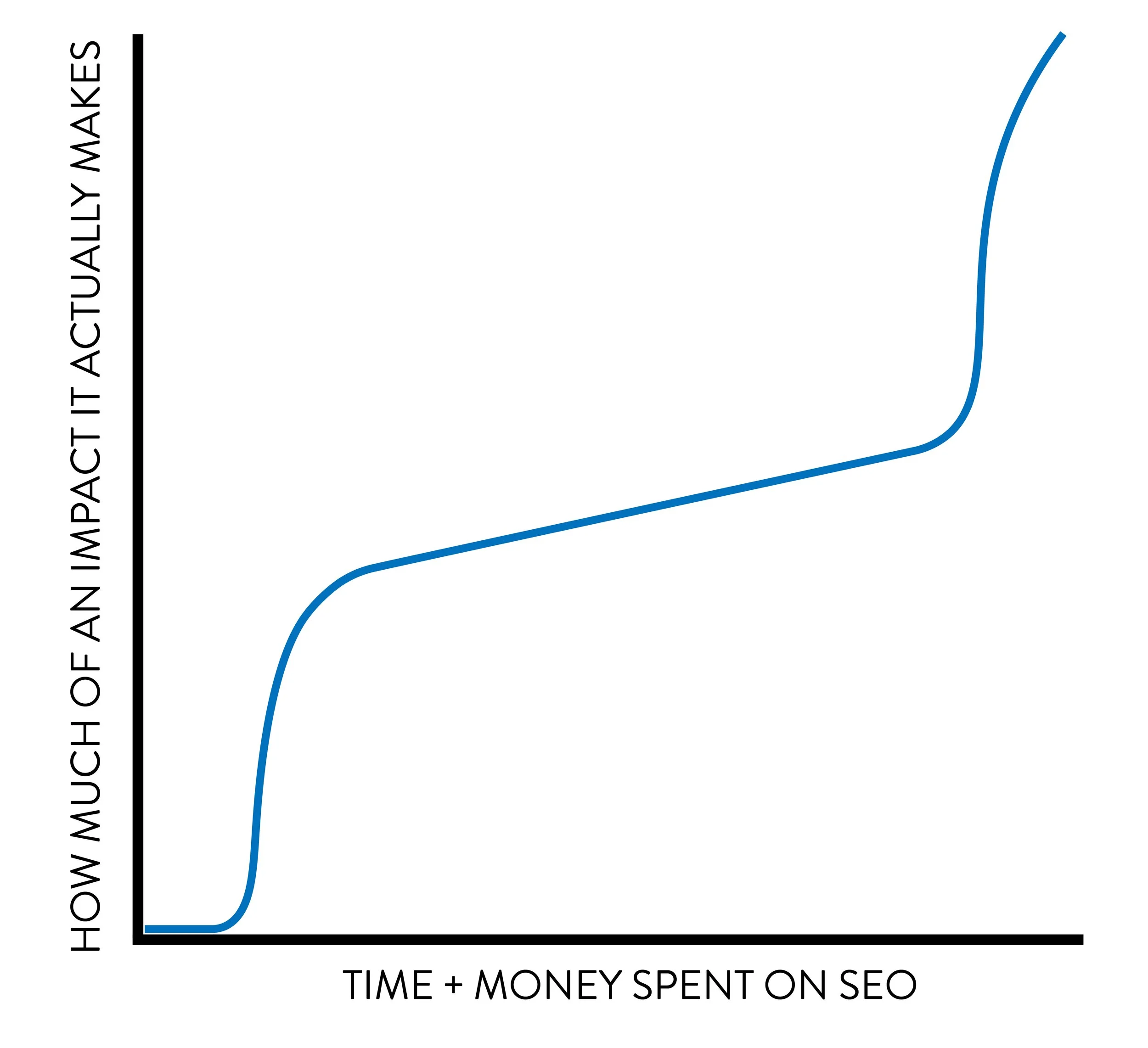
Everyone talks about wanting to improve their ranking but it’s a bit imaginary. You don’t know your ranking. You never will. Google will give you analytics on how your site performs but you’re not seeing a physical number. While all of this talk on SEO is important, I really do want to emphasize the point of not stressing too much over it. This shit is constantly changing and it’s all a bit unpredictable so the message is just do what you can. What matters most is that you’re at least doing something. Doing a little bit for your SEO is a fuck load better than doing nothing. If you don’t have a huge budget to hire out for SEO, at least get yourself to that first hump on the chart below and you can get there by yourself with free or very affordable resources.
SO HOW DO YOU IMPROVE YOUR SEO?
As I mentioned, there’s a ton of ways to do this. This could be an entire book so I can’t cover every single thing you can do in a blog post. If you’re not already, you can follow along on Instagram where I have a series breaking down everything I do for my small business but for the purpose of this blog, I’ll break it down into the 3 main categories: keyword research, off-page SEO, and on-page SEO.
KEYWORD RESEARCH HELPS YOU FIGURE OUT WHAT PEOPLE ARE SEARCHING FOR
When people talk about SEO keywords, these are specific words, phrases, or questions that people are typing into search engines. When the little bots comb through your site, they’ll find these keywords that you’ve added and have a better understanding of the content. When people search for those keywords, Google will put your site on the results page because the bots have determined that your site helps answer that search. Keyword research is important to find out what people are searching for, find variations of keywords you may not be thinking of, and find which keywords you actually have a shot at showing up for. To learn a little bit more about how to find keywords, you can check out my other blog post on keyword difficulty (when you get there, it’s actually about how blogs can improve your SEO but throughout are a bunch of suggestions on how to find keywords).
OFF-PAGE SEO IS LIKE YOUR WEBSITE’S REPUTATION
Off-page SEO is everything outside of your website that proves you’re a quality site with valuable information. These are external sources that serve as social proof that you have a reputable website. Off-page SEO includes things like:
Writing a guest blog on another website with backlinks to your site
Positive Google reviews
Any features on podcasts or webinars
Having your Google business account properly set up
An active social media presence
ON-PAGE SEO IS WHAT YOU’RE ACTUALLY DOING TO YOUR SITE
Here is where you’re going to put most of your effort. Those keywords we talked about? You’re going to make sure they’re included in your website copy. The main goal here is to address the needs/questions/concerns of your audience and create your site in a way that’s engaging, welcoming, and easy to use. This includes accessibility features like making sure there’s enough color contrast that your text is legible, writing alt-text on your images, and remembering to optimize your site to work well on a phone.
Together, all of these categories help to boost your website’s credibility, help inform Google what you do through keywords, and ultimately increase your ranking so you show up higher when people search for your product or service.
NOW LET’S BE SURE YOU DIDN’T MISUNDERSTAND ME
If you read this and thought “perfect…I’ll just use AI to do some keyword research and then have it write all of my website copy filled with keywords to make sure I’m doing everything I can for SEO”, I DON’T THINK SO. Keyword research is important but you want to resist the urge to create your site for search engines. Some of the main things that negatively impact your SEO are:
Keyword padding: throwing in as many keywords as possible, especially to the point where your text reads unnaturally
Automatically generated content: this includes descriptions generated by your website platform if you don’t go in and change them on your own, copied content from other sites, or content that sounds (or is) AI generated
Cloaking: when you show crawlers different pages than what the public sees
Link schemes: using shady methods to get other sites to link back to your site, think like how people can buy followers on social media
The main takeaway: if you think you can outsmart Google, you can’t. It’s fucking Google, how smart do you think you are? It will be able to tell when you’re creating a website for a search engine instead of your audience. What SEO rankings prioritize most is designing a website for humans, not search engines. They want to see that your site is engaging, easy to navigate, and reader-friendly. The best thing you can do for SEO is to create a unique site that engages with your audience and provides valuable information.
SO WHAT DO YOU DO NEXT?
Now that you’ve got a basic understanding of what SEO is, you can get started implementing There’s a lot you can learn on your own. Semrush has some great resources as does Moz. Google will also give you some advice on what you can be doing. As I mentioned you’re more than welcome to follow along on Instagram as I share what I do and maybe this will turn into a follow up blog with where to get started If that’s something you’re interested in, be sure to comment “we want more” below and I’ll get to work on blog #2.
ABOUT THE AUTHOR:
ERIN KELLY-SULLIVAN

When you bring someone in to help with your business you really want them to understand your needs. My time as a PT gives me that background to truly understand your business, your target audience, and the field. If you want to work with someone who gets you, my specialty is helping fellow physical therapists, strength coaches, and anyone in the health and performance field reach their branding goals.
READY TO BOOST YOUR INSTAGRAM PRESENCE?

This course will give you the foundational design concepts to create visually impactful posts to help boost your brand.
Build your strategy, create your templates, and watch your brand take off.
READ MORE
WANT MORE HELP LIKE THIS? FOLLOW ALONG ON INSTAGRAM:


Not sure what to post next? Here are 5 types of posts that are non-negotiable for physical therapy clinic owners.